Corrosion Monitoring
From Measurement to Assured Performance
From Measurement to Assured Performance
JST delivers complete corrosion monitoring solutions — from field measurement and system deployment through data analysis, interpretation, and integration into integrity management strategies.
We combine corrosion engineering expertise with proven technologies — partnering with global leaders including Cosasco® and BORIN® Manufacturing Inc. — to deliver monitoring systems that provide reliable, actionable data.
We don’t just collect data — we engineer, implement, and support monitoring systems that perform in real operating environments.
End-to-End Delivery
A disciplined, phased approach from corrosion engineering through long-term integrity management.
Corrosion Engineering & System Selection
Identification of degradation mechanisms and selection of monitoring techniques aligned with process conditions, materials, and risk.
Monitoring Systems & Products
Supply of industry-proven technologies for comprehensive corrosion and erosion monitoring.
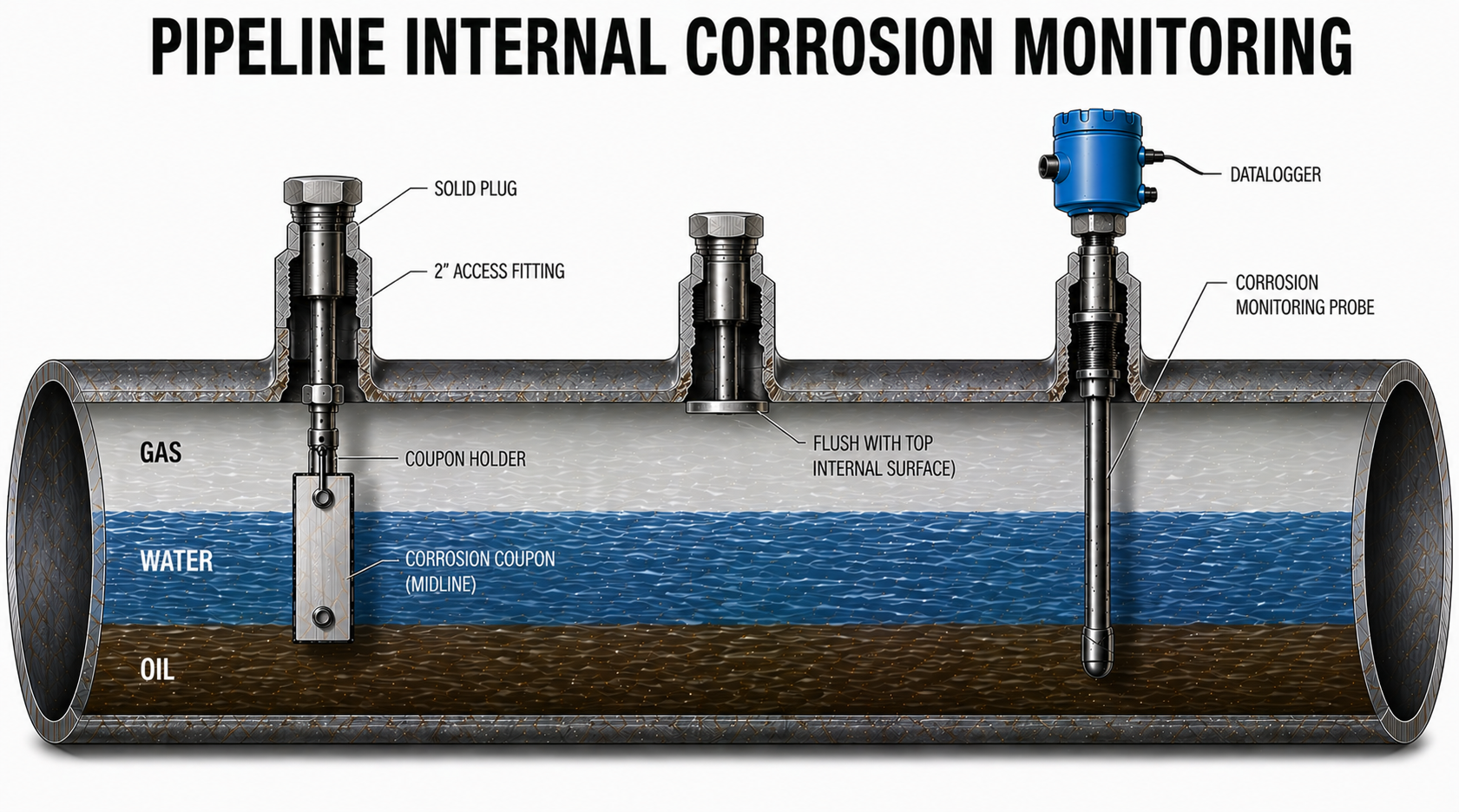
Corrosion Coupons (Weight Loss)
Proven and widely accepted method for direct measurement of corrosion rates under actual operating conditions, supporting long-term corrosion assessment and inhibitor performance evaluation.
Electrical Resistance (ER) & High-Sensitivity ER (HSER) Probes
Continuous monitoring solutions for detecting metal loss in real time, suitable for both general and low corrosion rate environments, including challenging multiphase systems.
Linear Polarization Resistance (LPR) Probes
High-sensitivity probes designed for instantaneous corrosion rate measurement in conductive fluids, enabling rapid response to process or chemical changes.
Sand / Erosion Monitoring
Real-time monitoring of erosion rates caused by sand or solid particles, supporting effective management of erosion-related risks in production systems.
Non-Intrusive Wall Thickness Monitoring
Ultrasonic-based solutions for external, non-invasive measurement of wall thickness, enabling early detection of corrosion or erosion without process interruption.
Environmental Condition Monitoring
Measurement and integration of key process parameters such as temperature, pressure, and flow conditions to enhance data interpretation and support accurate corrosion evaluation.
Galvanic (ZRA) Probes
Zero resistance ammetry measures the galvanic current between two electrodes to flag oxygen ingress, biocide changes and process upsets in water systems.
Atmospheric Corrosion Monitoring (Air IQ)
Cosasco Air IQ measures the corrosivity of the air in control rooms, switchgear rooms and electronics cabinets in real time, graded to ISA 71.04, alongside humidity and temperature.
Corrosion Under Insulation (CUI) Monitoring
Sensors fitted beneath the cladding detect moisture and metal loss on insulated lines and vessels, so insulation is removed where the data says, not on a guess.
Chemical Injection Systems
Engineered systems for controlled dosing of corrosion inhibitors and production chemicals, enabling optimisation of chemical usage and integration with monitoring data for closed-loop management.
Delivered through established partnerships with

Cosasco®
BORIN® Manufacturing Inc.
Ensuring reliability, accuracy, and long-term support.
Installation, Commissioning & Testing
Deployment of monitoring systems within operating facilities, with verification of installation, functionality, and data acquisition.
Data Collection & Engineering Analysis
Acquisition and interpretation of corrosion data to determine corrosion rates, trends, and system performance.
Inspection & Verification
Integration of monitoring with inspection techniques, including NDT methods, to validate data and confirm actual asset condition.
Integrity Management & Optimisation
Use of monitoring data to support risk-based inspection (RBI), maintenance planning, and optimisation of corrosion control strategies.
Why Corrosion Monitoring Matters
Corrosion is complex, often localised, and not always visible. Without effective monitoring, degradation can progress undetected until failure occurs.
Early identification of corrosion activity
Understanding of corrosion drivers — process, environment, and materials
Verification of corrosion control system performance
Data-driven inspection and maintenance decisions
Without reliable data, corrosion management becomes assumption-driven rather than evidence-based.
Understanding the Techniques
Corrosion monitoring combines measurement and verification to build a complete picture of asset integrity.
Measurement
Monitoring Systems
- Corrosion coupons for direct metal loss assessment
- ER probes for continuous corrosion rate monitoring
- LPR probes for real-time electrochemical measurement
- Galvanic monitoring (ZRA) for environmental interaction
- Advanced monitoring including biological, environmental, and ultrasonic systems
Monitoring provides continuous data…
Verification
Inspection Techniques
- Ultrasonic Testing (UT)
- Radiographic inspection
- Magnetic flux leakage
…while inspection confirms actual condition — together forming a complete understanding of asset integrity.
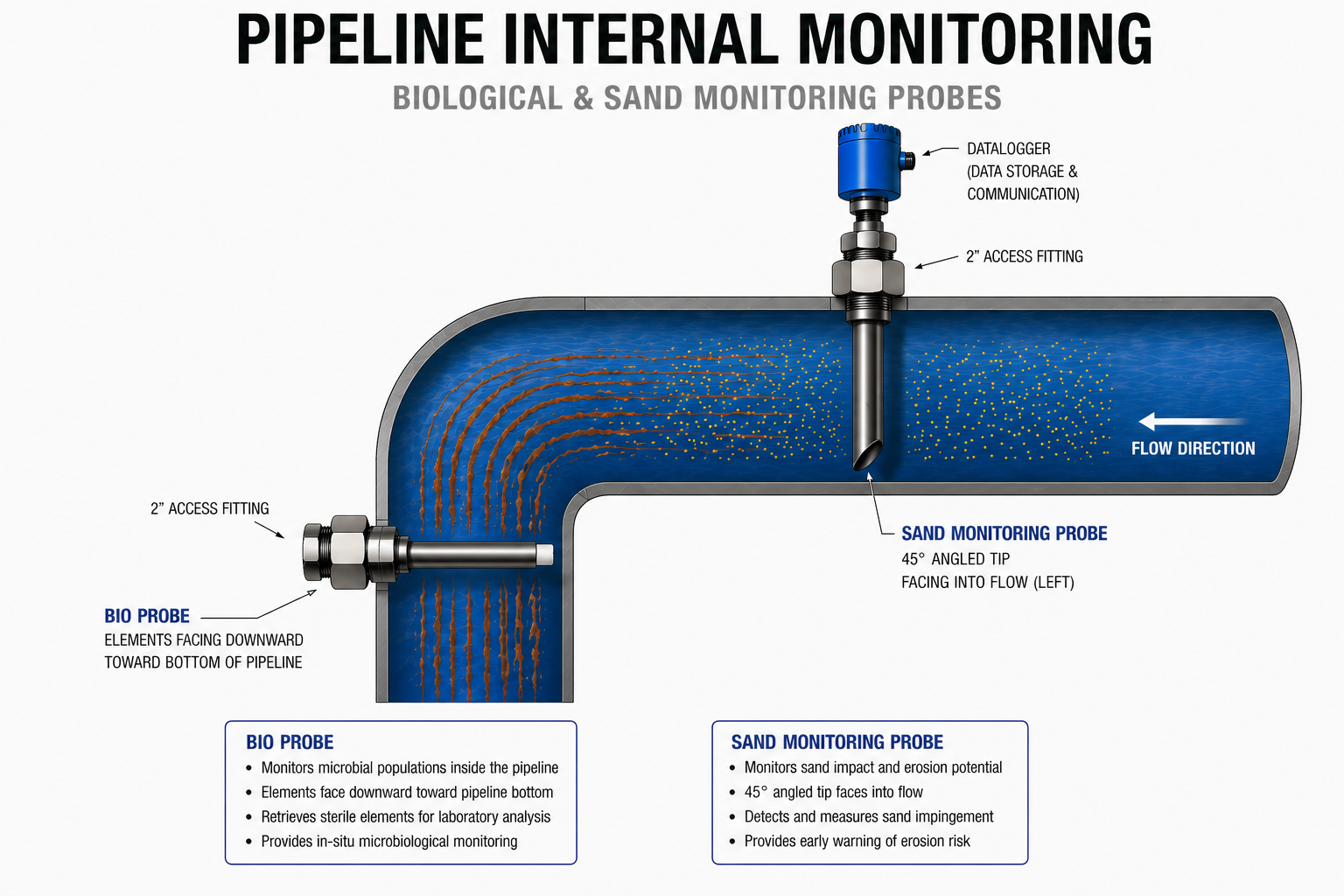
Biological & Sand Monitoring Probes — elbow configuration showing bio probe orientation and 45° angled sand monitoring probe facing into flow
Engineering Response
Effective corrosion monitoring requires more than instrumentation — it requires engineering interpretation.
JST ensures that monitoring systems deliver a clear understanding of asset condition, risk, and required action.
Selected based on actual degradation mechanisms
Positioned to capture representative and reliable data
Interpreted within the context of operating conditions
Integrated into inspection and integrity management strategies
Aligned with International Standards
Aligned With
- AMPP (Association for Materials Protection and Performance)
- American Petroleum Institute (API)
- International Organization for Standardization (ISO)
- American Society for Nondestructive Testing (ASNT)
Covering
- Corrosion monitoring and data interpretation
- Inspection and validation (NDT)
- Integrity management and risk-based inspection
Frequently asked questions
It measures how fast metal is being lost inside pipes and vessels, using probes and coupons at access points, so operators adjust inhibitor dosing and plan repairs on data rather than on failures.
Cosasco corrosion coupons, electrical resistance and linear polarisation probes, high-pressure access fittings, retrieval tools and data loggers, including wireless and online systems for remote sites. JST is the Cosasco partner in Thailand.
Yes. Trained technicians use pressure-rated retrieval tools to change coupons and probes without a shutdown, and also replace coupons offline during planned shutdowns, most recently at the Arthit field for PTTEP.
Most operators change and weigh coupons every 60 to 90 days. Electrical resistance probes give a continuous reading and are used where corrosion rates change quickly or access is difficult.
Yes. Coupons are cleaned and weighed to ASTM G1, corrosion rates are reported in mm per year with photographs, and trends are reviewed by a corrosion technologist who recommends treatment changes.
Monitoring measures corrosion while the plant runs, using coupons and probes at fixed points, and reports a rate in millimetres per year. Inspection, such as ultrasonic thickness, radiography or magnetic flux leakage, confirms the actual condition of the metal at the time of the test. We use both: monitoring to catch a change early, inspection to verify it.
Coupons are the simplest and work in any environment, but give one result per exposure period. ER probes work in any fluid and give a continuous metal-loss reading. LPR probes give an instant corrosion rate, but only in conductive, water-based fluids. ZRA measures the galvanic current between two electrodes and is used to detect oxygen or biocide changes. Most programmes combine two or more at the same access point.
Yes. Cosasco Air IQ monitors the corrosivity of the air in control and electrical rooms in real time, graded to ISA 71.04, so sulphur gases are caught before they damage circuit boards. For insulated lines we fit corrosion-under-insulation sensors beneath the cladding, so insulation is only stripped where the data shows moisture or metal loss.
Defined by Data. Proven in Operation.
Our corrosion monitoring engineers are ready to evaluate your requirements and design a solution that delivers reliable, actionable data.